
There are places that tell the history of a city better than any book. This is precisely the case with Fadrell Castle —also known as Castell Vell—. It is perched on Magdalena hill, just eight kilometers from the center of Benicàssim and about ten from Castellón, and it is of Islamic origin. This means it has dominated the Mediterranean coastal plain for more than ten centuries.
And so that you come to visit Castell Vell de Fadrell prepared, we are going to give you a very brief summary of its history, tell you what to see inside the enclosure, how to get there, what the descent from Fadrell Castle is like, and the opening hours of the Interpretation Center.
Let’s go!
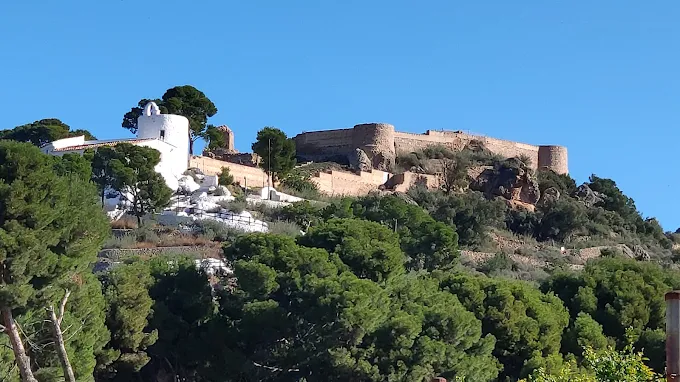
History and Muslim origins of Fadrell Castle
The first humans to occupy Magdalena hill did so long before any castle existed. There is evidence of settlements here since the Bronze Age, but it wasn’t until the Hispano-Muslim era, in the 11th century, that a construction of this type was first recorded.
However, most of the structures you can see today correspond to an Almohad castle from the second half of the 12th century, which served as the district capital until the Christian conquest.
In 1233, Castell Vell was usurped by James I, who distributed the territory among his lords so that, a few years later, the Privilege of Transfer was granted to the population —to what we now know as Castellón— leaving the fort completely abandoned.
How to get to Fadrell Castle and the ascent route to Magdalena hill
To reach Fadrell Castle by car, take the N-340 and connect with the CV-147 until the turn-off with signs for the Magdalena Sanctuary; the Castell Vell Interpretation Center is right there. Driving is the most comfortable option, although you can also get there by bike.
The Ascent
From the Interpretation Center, the self-guided itinerary to the castle grounds begins. The ascent and tour take approximately 45 minutes at a leisurely pace, following the marked trails. A walk that deserves a spot on your list of things to do in Benicàssim, especially if you enjoy hiking.
Enjoy the vegetation as you ascend; the surroundings are full of white pines, carob trees, and olive trees, and the six stops along the route. At the Interpretation Center itself, they hand out brochures with the itinerary, and if it’s not open, here you’ll find all the information and a free audio guide.
The descent from Fadrell Castle follows the same path as the ascent. It’s not a difficult route, but it is stepped; be careful with the unevenness and obstacles.
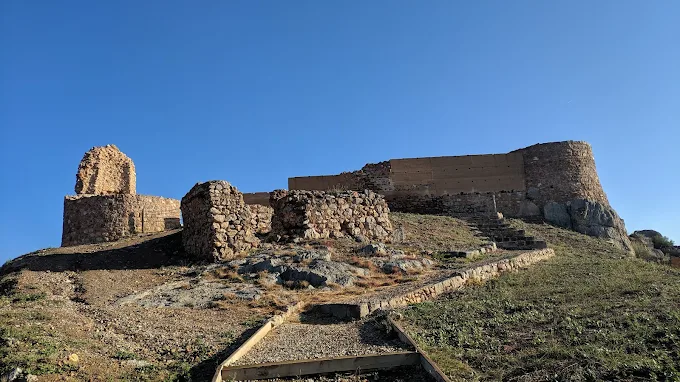
What to see within Fadrell Castle grounds
Shall we tell you about the most important elements of the enclosure?
But first, let us tell you that Fadrell Castle follows the Hispano-Muslim tripartite model: with three independent walled enclosures —the alcazaba, the albacara, and the arrabal or settlement— each with its own function.
The Alcazaba
This is the highest and most protected part of the castle. The most interesting features here are its four circular towers guarding the corners and its five cisterns, which are water reservoirs excavated directly into the rock. This enclosure functioned as the command center from which the entire district was administered.
The Albacara
Located just below the alcazaba, this area functioned as a giant granary for storing harvests and tributes. In fact, remains of up to 15 two-story warehouses have been found. Here you will also see a huge cistern which, centuries later, served as the base for building the structure of the current hermitage.
The Magdalena Hermitage
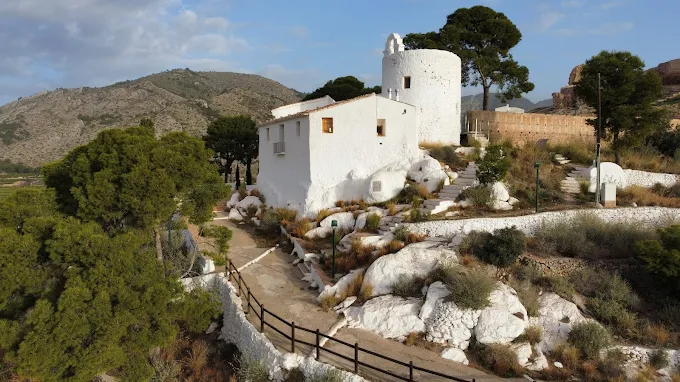
It is the main Christian element of the complex. It was built in the 15th century, utilizing ancient structures; for example, its bell tower was originally a circular Islamic tower. And, if you look closely, it still retains a tiny detail that hints at its origin: a horseshoe arch-shaped window.
The Andalusian House
This is possibly the most special visit on the tour because it consists of the remains of a real 800-year-old dwelling. You can clearly distinguish the model of a house with a central patio, the living room, the kitchen, and even the latrine. Thanks to the plates and oil lamps recovered here, it was possible to document what life was like.
The Village Walls
This is the most extensive area of the enclosure, where the population lived in streets built on terraces. Although much of it remains underground, it is an archaeological area that continues to yield surprises, such as the 500-meter-long section of wall located just a few years ago.
Prices and Visiting Hours
Entry to the grounds and the itinerary is completely free. The only thing you should keep in mind, if you want to delve into the subject at the Interpretation Center before ascending, are its opening hours. If you catch it open, they will provide you with a brochure, directions, and you can watch a ten-minute video that serves as an introduction to the visit. And if you want to complete your route, you can also find information here about Montornés Castle, another charming nearby fortress.
During summer hours —from April 1 to September 30— it opens Tuesday to Saturday from 10:00 AM to 1:00 PM and from 5:00 PM to 8:00 PM. And in winter —from October 1 to March 31—, Tuesday to Saturday from 10:00 AM to 2:00 PM and from 4:00 PM to 6:00 PM. On Sundays and holidays, you will be welcomed with the same hours all year round, from 10:00 AM to 2:00 PM.
Coming to Benicàssim? Stay with us
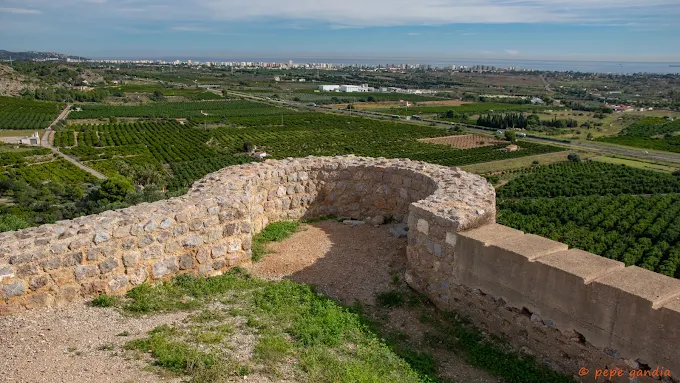
If you’re looking for what to see in Benicàssim, Fadrell Castle must be among your chosen monuments and landmarks. It has it all! It’s part of the Desierto de las Palmas —an exceptional natural enclave—, holds impressive stories within its walls, offers views of the Mediterranean, and, even better, the ascent to it is most pleasant.
If you want to take the opportunity to see Fadrell Castle and other attractions in Benicàssim such as Playa Heliópolis, the Ruta de las Villas or the Vía Verde del Mar, you just have to click here and stay in one of the apartments, villas, houses or studios we have in Orange Costa. There’s no better ingredient for your vacation!

